
Private Viewing
SNØ
Edvard Munch  ·  circa 1913–15
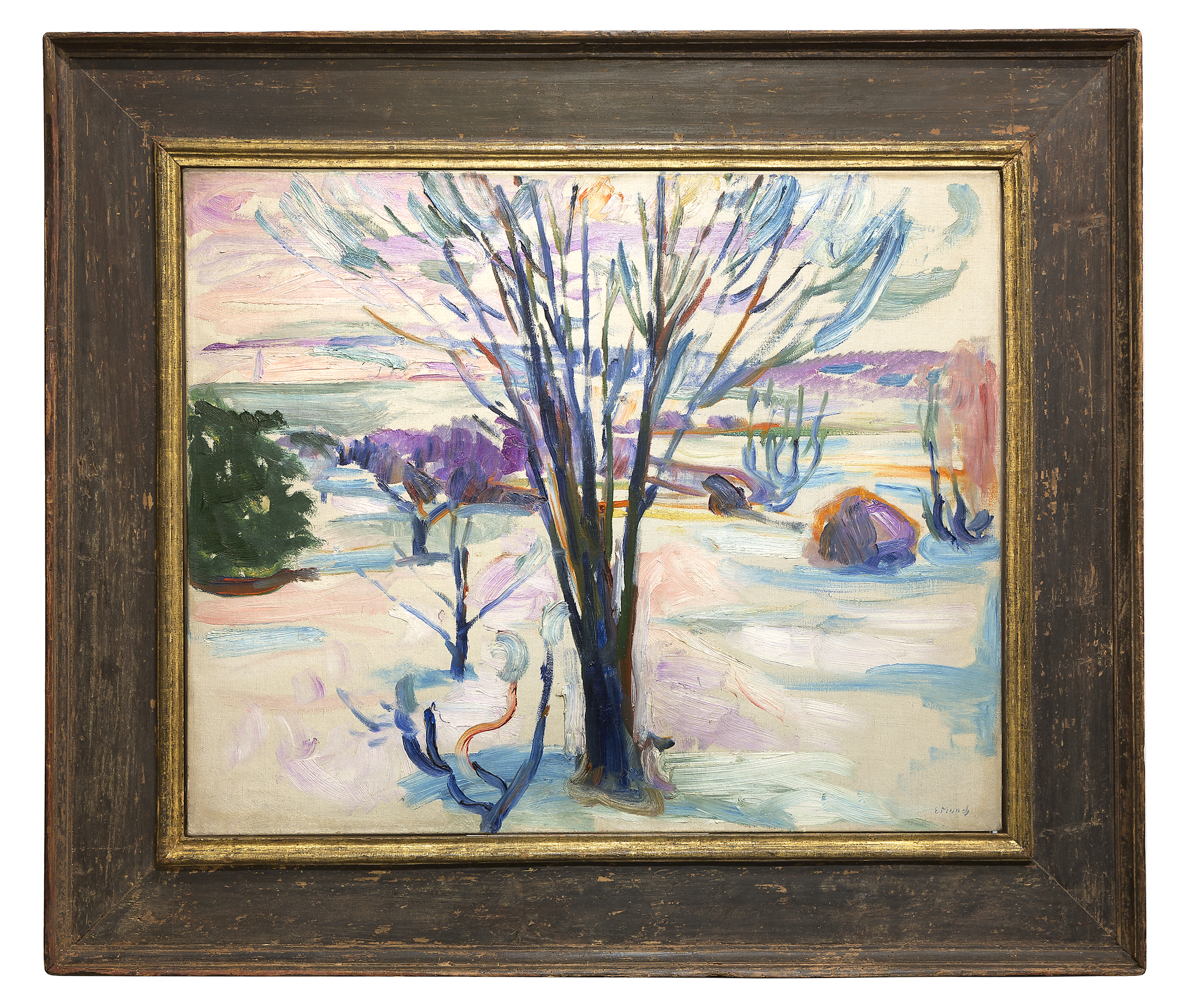
Snow (Schnee) — Edvard Munch — in original frame
Edvard Munch  ·  1863–1944

SNØ

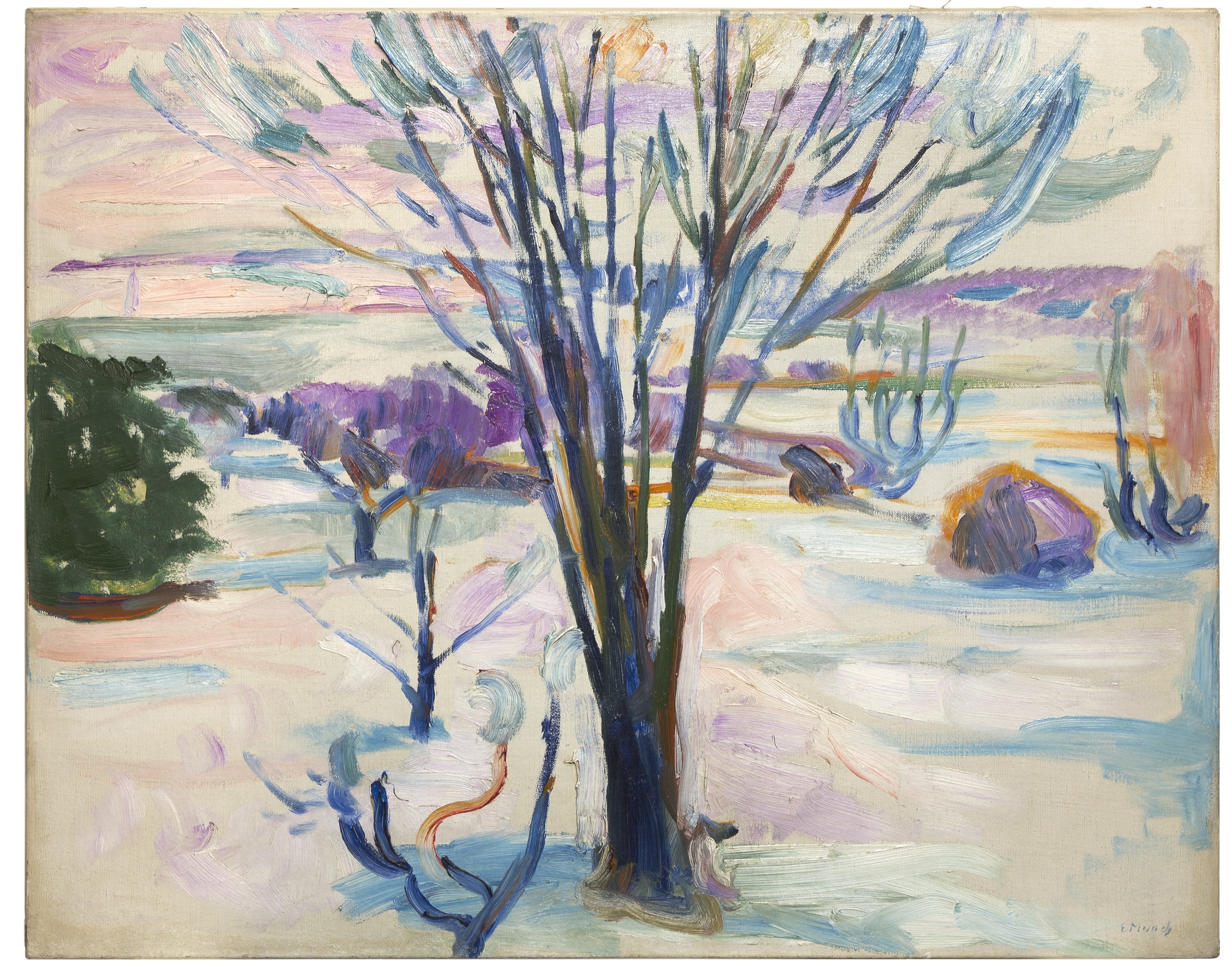
Snow  ·  Schnee  ·  Winterlandschaft in Jeløya  ·  circa 1913–15

Medium
Oil on canvas
Dimensions
68 × 80 cm26¾ × 31½ in
Signed
E. Munchlower right
Painted
Jeløya, Norwaycirca 1913–1915
Catalogue raisonné
Woll no. 1048Vol. III, 1909–1920
About the Work

Painted on Jeløya, a quiet agricultural peninsula in the Oslofjord south of Oslo, Snow belongs to one of the most fertile and transformative periods of Munch's long career.

In 1908, after years of mounting psychological crisis, Munch voluntarily admitted himself to Dr. Daniel Jacobson's clinic in Copenhagen. He emerged in 1909 profoundly changed, and turned his gaze permanently back to Norway — settling in the coastal landscapes of the Oslofjord region. Where the 1890s had produced the existential intensity of the Frieze of LifeThe Scream, Madonna, Vampire — this new phase brought a different kind of radicalism: open skies, winter fields, and the elemental Norwegian light translated through a palette that owes as much to Fauvism as to Northern Expressionism.

Snow was painted circa 1913–15, during repeated stays on Jeløya. The island's gently rolling landscape, beech forests, and the flat coastal light reflecting off frozen ground provide the painting's precise topography. A single bare tree — rendered with extraordinary directness in deep Prussian blue — anchors the centre of the composition. Beyond it, the snowfield dissolves into lilac shadow and distant warmth: an orange horizon, a darkened haystack, the cold suggestion of water. The palette is limited but exact. This is winter not as metaphor but as phenomenon, observed with the eye of someone who understood cold light.

The work was first exhibited at Blomqvist Kunsthandel in Kristiania in 1915 — very possibly the same season it was completed. It passed directly from its first owner on Jeløya through a sequence of the most distinguished names in twentieth-century Expressionism: Fritz Nathan and Peter Nathan in Zürich; Galerie Henze & Ketterer in Switzerland; Marlborough Fine Art in London. Most recently, it was included in Bonnard and the Nordics at the Nationalmuseum Stockholm and Lillehammer Kunstmuseum in 2025, confirming its continued institutional relevance.
The Artist's Period
The years 1909–1916 are widely recognised as Munch's landscape decade: a period of physical vitality and formal clarity following the turbulent 1890s. He was simultaneously completing the monumental Aula murals for the University of Oslo, won by competition in 1909.
Jeløya
A narrow peninsula in the Oslofjord near Moss, known for its gentle agricultural terrain, beech forests, and the soft, horizontal light of the Norwegian coast. Munch worked here through several winters in the early 1910s, producing a group of landscapes of which Snow is among the finest.
The Catalogue raisonné
Fully documented as no. 1048 in Gerd Woll's authoritative four-volume Catalogue raisonné of paintings by Edvard Munch (2009) — the definitive scholarly reference for his complete painted oeuvre, published in association with the Munch Museum, Oslo.
The Frame
The painting is presented in its period frame — a dark wood moulding with gilt liner, consistent in character with Norwegian exhibition practice of the 1910s.

The Painting
Snow (Schnee) — Edvard Munch — unframed canvas
Oil on canvas  ·  68 × 80 cm  ·  Unframed Click to view full resolution
Snow (Schnee) — Edvard Munch — with original frame
With original period frame Click to view full resolution
Details

Provenance
c. 1915
Christen Sandberg
Jeløya, Norway — acquired directly, likely from the artist during Munch's working stays on the island
1927
Mrs Sandberg
Jeløya, Norway — by descent
1955
Carl Steinbart
Berlin
1958
Fritz Nathan and Peter Nathan
Zürich — one of the foremost modern art dealing dynasties of twentieth-century Europe, with significant holdings in Northern European Expressionism
1969
Galerie Henze & Ketterer
Switzerland — founded by Roman Norbert Ketterer (1912–2002); among the world's pre-eminent specialist galleries for German and Northern Expressionism
1993
Marlborough Fine Art
London — founded 1946 by Frank Lloyd and Harry Fischer; one of the most influential galleries in twentieth-century art
1993–96
Private Collection
London
1996
Christie's London
Sale: 3 December 1996, Lot 232
1996 —
Private Collection
Oslo
Private Collection
Switzerland — acquired from the above

Exhibition History
1915
Blomqvist Kunsthandel, Kristiania
Edvard Munch
Catalogue no. 25
1916
Bergens Kunstforening, Bergen
Edvard Munch — Utstilling 1916
Catalogue no. 21
1927
Nationalgalerie, Berlin
Edvard Munch — the first major museum retrospective of the artist's career
Catalogue no. 163
1958
Kunstmuseum, Bern
Edvard Munch 1863–1944
Catalogue no. 65
1999
Blaafarvevaerket, Modum
Sommeren med Edvard Munch og Arne Kavli
Catalogue no. 37
2025
Nationalmuseum Stockholm & Lillehammer Kunstmuseum, Lillehammer
Bonnard and the Nordics

Bibliography

G. Woll, Catalogue raisonné of paintings by Edvard Munch, Volume III, 1909–1920, London, 2009, no. 1048

H.-M. Flaatten & Frydenberg, Edvard Munch i Moss. Kunst, krig og kapital på Jeløy 1913–1916, Moss, 2014, p. 221

G. Dyvesveen, Edvard Munch i Moss 1913–1916, Moss, 2016, p. 50

Munch Museum online record: munch.no/objekt/PE.M.00204 ↗  ·  Inv. PE.M.00204


Image Archive
TIFF · Archival
Edvard Munch — Snø — With Frame
3,067 × 2,760 px  ·  25 MB  ·  Uncompressed
Open in Google Drive ↗
TIFF · Archival
Edvard Munch — Snø — Canvas
4,817 × 3,780 px  ·  109 MB  ·  Uncompressed
Open in Google Drive ↗

Condition

A full condition report is available upon request. Interested parties are invited to contact eiklid / rusten directly to arrange an in-person viewing and access to complete documentation.

Enquire

To enquire about this work, arrange an in-person viewing, or request the full condition report and documentation, please contact us directly.

Contact Gard Eiklid
Gallery eiklidrusten.no